Wednesday, June 02, 2010

Associative and distributive properties of multiplication

Illustrating a not uncommon confusion

Recently, working with a student who was preparing for the Algebra portion of a test, we came across this problem about simplifying the radical expression 3*sqrt(27).
He factored 27 = 9*3, and he wrote
3*sqrt(27) = 3*sqrt(9*3) = 3*(sqrt(9)*sqrt(3)) = 3*(3*sqrt(3))

Then he paused, hesitated, stopped, and he silently looked at me, telling me with his look that he didn’t know what to do next, pointing his pencil to the parenthesis, and the multiplication inside the parenthesis.
I said: “Probably the problem here is not asking for decimals, maybe we can do this multiplication first”, and I wrote
9*sqrt(3)

Then he asked: “But, don’t you have to also multiply the first 3 times the sqrt(3), as well?”
At that point I saw his confusion. It was about the associative property of multiplication, and the distributive property of multiplication over addition.
He was thinking that because
a(b+c) = ab + ac
maybe then
a(bc) would have to equal ab*ac, instead of just (ab)c.

So I did a quick example with numbers. First I wrote:
2(3+5) = 6 + 10 = 16
and then
2*(3*5) = 2*15 = 30, to establish a firm reference.
Then, making explicit how the associative property works in this particular case, I wrote:
(2*3)*5 = 6*5 = 30
Finally, showing the mistake of trying to distribute multiplication over itself, I wrote:
(2*3)*(2*5) = 6*10 = 60 which is different from 30.

Looking at this example the student agreed that the first procedure (using the associative property of multiplication) gives the right answer, while the second (trying to distribute the multiplication symbol outside the parenthesis over the multiplication inside) doesn’t work. After having the formats clearly illustrated with whole numbers, I wrote them with variables, for him to see the difference in the abstract level.
In this particular instance, the confusion arose in the first place because of the square root symbol in the factor sqrt(3).

When a triple product a(bc) involves only whole numbers, students don’t have a problem with that. They just multiply the two numbers inside the parenthesis, and then multiply that product by the number outside the parenthesis. However, for many students, the presence of a radical makes the problem a little bit too abstract. They don’t have a ready answer for 3*sqrt(3), so they think: “I don’t know how to do that multiplication, so I don’t know how to do the problem,” or “That multiplication cannot be done without a calculator, so I have to apply some rule but I don’t know which one.” Once in the abstract realm of properties, formulas, and identities, their chances of getting lost increase dramatically.

This type of confusion is actually quite interesting. Students often fail to make a connection between variables and numbers. They seem to forget that variables stand for numbers. However, here the student was applying the connection in one way, from the abstract rule to the concrete example. The problem was the rule he was applying was made up. It is not a rule at all. It only seemed a rule to him because of its typographical similarity with the distributive property of multiplication over addition.

First, the presence of a radical disconnected him from the concrete, familiar realm of whole numbers. Then he went searching his memory banks for an algebra rule to apply. The first rule he remembered was the distributive property. At that point, an oversimplification drive took over, suggesting the idea that the typographically corresponding expression should be a rule as well. So he was considering adopting such a made-up rule as a real number property, without checking its validity with numerical examples before applying it but just going by the typographical similarity with the distributive property, effectively making him want to distribute multiplication over itself.

Friday, March 26, 2010

Why are there so many numbers?

Where are they?

In my math tutor practice I constantly answer questions. I usually get a lot of questions from my students. All kinds of math related questions. Some of them are very common, meaning, I get them all the time. For example, Calculus and Pre-Calculus students very often ask: “What is the domain?” “How do I find the domain of a function?” The vast majority of standardized test takers ask questions to the effect of “Why do I have to re-learn all this math stuff?” “When am I ever going to use it?” Sometimes I get questions that make me laugh, like: “How can you stand so much math? My head hurts!” and “Do you also have a real job? Or, is this all you do?”
Recently a student asked me a couple questions I found just fascinating. We were going over some algebra rules. I started giving her some numerical examples to illustrate one of the rules. All of a sudden my student asked: “Why are there so many numbers? Where are they?” These are great questions! They get to the root of the concept of number. Just think about these questions for a moment. “Where are they?” Where are the numbers? It is almost like asking: “Where do numbers come from?” or even “How can I believe numbers really exist? Can I see them?” It is clear numbers are not physical objects but we use them to count physical objects all the time. You believe in the existence of something concrete, like cars, because you can easily see them (often in big numbers), but what about numbers themselves? Do we ever get to see a number? What we usually call numbers, like street addresses, or numbers in license plates, or ID cards, or page numbers in a book, all those are not actually numbers but numerals, the symbols we use to represent numbers. Numbers are in our mind. They are concepts, ideas, thoughts, more than things. My answer to these questions was along the following lines:
Numbers are everywhere. We do not see the numbers but we put numbers on the things we see. Numbers show up as soon as you are able to tell differences and similarities. Think about counting the chairs in this coffee shop, for example. When you count the chairs you do not count the tables, or the bookcases, only the chairs. So you count them because they are equal, they are all chairs. However, you do not keep pointing your finger at the same chair while going 1, 2, 3,.. You count that chair and immediately you go on to the next chair for the next number. So you count them with different numbers because they are all different chairs. What makes counting possible is our ability to identify a set of objects that are all equal, in a sense, yet different, in another sense. So we can “see” numbers when we look at the stars, at the grains of sand in a beach, or the cars in a highway, and so on. As long as our mind sees the world in terms of “equal” and “different,” numbers will be there, everywhere.

Saturday, February 06, 2010

Helping Students Find Their Own Motivation To Learn

What is in it for the student, from the student's own perspective?

It is important for students to understand teachers are helping them to figure out what they want to do in life, and are helping them achieve those goals. It is not enough for teachers to give students examples of what students do not want to do in life. Teachers want to inspire students to learn; to give them an appreciation for knowledge; to show them how to put value into knowledge, and how to extract value from it. For working adults is easier to see how, in this technological world of ours, meaningful numerical patterns come from everyday life. Numerical patterns coming at us directly from real life make us think about reality in terms of numbers. The more comfortable we are with numbers, and with handling them, the better we can express the ideas suggested to us by those numerical patterns. Sooner or later, in one form or another, we realize the math we currently know is somehow inadequate to analyze the data we want to understand. Even for students who have always been good at math, there may come a point where their homework problems baffle them. This may be because such students tend to enroll in AP classes at an early age. By the time they are high school seniors, they are already covering material some science majors only get to learn about in their college sophomore year. Therefore, it is important for students to create good study habits since early in life. Study is not only preparation for work but study in and of itself can be an awful lot of work. Given that study takes time, energy, and other resources, it is important for students to be able to associate it with experiences of achievement, and empowerment. Success means different things for different people; it even means different things for the same person at different points in their life. Often students question themselves: "Is this effort worthwhile?" Some sort of confirmation is needed about it. The discipline of doing homework with a good degree of concentration, regardless of whether or not we like a particular subject that much, pays off when, thanks to that consistent effort, we are able to see the things that interest us in a new light. For many, it may mean just getting past a particular requirement, thereby clearing their horizon from a bulky obstacle. Clearing out such requirements can give students an improved sense of self-esteem, and a renewed confidence in themselves. Another important factor may be taking our time to learn things thoroughly, to make the subject ours, to make sure we really understand it, because then we know what to do at any given point, instead of feeling like randomly throwing darts in the dark, and hoping to achieve some result by chance. There are many factors involved in learning. Each student builds their own learning strategy, according to what they determine is best for them. Teachers can only hope to influence in some measure such decision making process on the student's part. Students constantly make these decisions on their own, multiple times a day, choosing the way they study, selecting what gives them the best possible outcomes in their own world, according to everything they consider important - not necessarily what other people consider important for them. For some students it is more important to find ways of having fun while learning. Others predominantly focus on their long term goals (passing exams with a good enough score) without almost ever giving themselves the chance to consider their learning experience from any perspective other than their test results. In summary, it is important for students to find educators who can provide them not only with facts but also with motivation enough for grasping those facts, and applying them.

Saturday, January 30, 2010

Solving systems of equations by substitution

A topic that is hard to explain because it is so simple

The substitution method oftentimes works as a powerful technique for solving systems of equations. This method is widely taught in middle and high schools, as part of the Algebra curriculum, along with the other standard methods for solving systems of linear equations in two variables: the elimination method, the graphing method, and the method of determinants (also known as Kramer's rule). Solving systems of equations by substitution is a very interesting process, especially when we consider that the fundamental basis of its concrete execution is not really any algebraic operation at all but a typographical one. Substitution means textual substitution. It is a typographical "find and replace" operation, whereby we combine two strings of characters into a new one, by means of "copy," "cut," and "paste" manipulations. It is a common experience for math teachers noticing many of their students get confused when learning the substitution method. I believe a big part of such confusion in the student's mind comes from the unexpected, unexplained, fundamental difference in nature between algebraic, arithmetic, numerical operations, on one hand, and such a typographical, textual, character-and-string oriented operation like substitution, on the other hand. Most teachers explain the substitution method by doing some examples on the board, and hoping that students will somehow "get it." Indeed, some students do get it. After watching the teacher doing a few examples, something clicks and, that is it, they now know it. They have gotten it. Moreover, usually they not only get it but they love it when they realize how it works. Unfortunately though, these students I refer to in the last few sentences, typically make up only between ten and twenty percent of the class. They are the intellectual high achievers of the class, many of whom will go on to careers in science, engineering, medicine, or money management. The other eighty to ninety percent of the class typically did not get it. They are confused, they do not know what is going on, they have no clue what the teacher did or is talking about. For them this is no happy experience. Actually, it can be really aggravating if the teacher is particularly enthusiastic about substitution but lacks the ability to infect the whole class with his or her enthusiasm. There are some particular examples of systems of equations that, when solved by substitution, seem to yield a spectacularly elegant and short solution. When students have not yet understood the substitution method, watching one of these spectacular solutions makes them feel like the teacher is practicing some mysterious magic trick in front of them. This only adds to their discomfort, and their distaste for math in general, since it is only natural to fear and/or reject what we do not understand. As a math tutor, I have the luxury of working with one student at a time, so I can focus my attention on delivering the particular information my student needs, in the way he or she wants to approach each problem. In the case of substitution, I make sure they understand how to do it, by doing the first example myself so slowly, so carefully, so explicitly, so spelled out, so mechanically, that I make my students feel for sure they can do it faster than me. When I explain solving by substitution I do not try to look smart. Instead, I become a machine, and I consciously take all the magic away from the process, so my student can clearly see how simple it is. The delivery here needs to be accurately tailored to each individual student. It is much harder to do this in front of a whole class, because teachers have to maintain their authority; and making the explanation so explicit that the last student in the class understands it, would probably lower the teachers' own status in the eyes of several other students. In part, substitution is difficult to teach and understand because it is so simple. Compounding the problem, we have to remember all the accumulated deficiencies students are still struggling with, and dragging behind since their first years in elementary school. When solving a system of equations by substitution, the actual substitution is only one step in the process. Even when it is done correctly, students still need to work their way through all the algebraic and arithmetic operations needed to solve the given problem. They very well may do the substitution correctly, only to mess up the problem two steps down the road because they do not know how to add/subtract negative numbers, or they do not know how to divide fractions, or they are still adding with their fingers.

Saturday, January 23, 2010

When it comes to math homework, slower is often better

Take your time to use the correct set of problem-solving questions

Students often approach math homework problems with the same level of interest and excitement many adults show when preparing their tax returns. They want to get them done, and over with, as soon as possible so they can do something else. Many times, this is the only interest students have in their math problems, just getting them done, and moving on to having some fun with any activity other than math. Ironically, though, this goal turns out to be counterproductive, since you can do something well and fast only when you already know how to do it. More often than not, however, homework is part of the learning process. Typically, when students do homework, they are still learning, still practicing. They have not yet mastered all aspects of the topic at hand. Very often homework problems present students with finer points they have not yet considered. We could say when students do homework they only partly know what they are doing, kind of. So their goal of finishing as soon as possible and go play, only causes them to get the problems wrong, because they use the wrong question: "What am I supposed to do here?" instead of the questions that can successfully lead them to correct solutions: "What do we have here?" "What does this mean?" "What is the question?" and "What can I do?"

Saturday, November 21, 2009

Exploring Math with the TI-89

Technology changes possibilities

The TI-89 is a graphing, programmable calculator with symbolic manipulation capabilities. I know that is a mouthful but we can break it down to three main features:

1) This device graphs not only functions of one variable; it also graphs functions of two variables, parametric curves, functions given in polar coordinates, and data from number tables.

2) Programmable means it has commands you can use for writing code that is directly executable on the device. You can save, edit, and execute programs in it. This gives you plenty of flexibility when it comes to calculations for complex problems, because you are not restricted to the built-in operations.

3) Symbolic manipulation means the device displays, and uses standard mathematical symbols like integral, derivative, roots, exponents, and fractions, in a way that is consistent with algebra rules. That means it is not only a number-crunching little machine, but it does many operations of algebra, and calculus, like factoring polynomials, solving equations, multiplying matrices, deriving functions, and finding definite integrals.

All these capabilities present opportunities for teaching math. For example, using this calculator it is very easy to show relationships between formulas of functions, and their graphs. Presenting these relationships in a book usually takes several pages. Students often have some trouble reading, believing, understanding, remembering, and applying the general rules for this level of algebra of functions. On the other hand, typing the examples from the book into the calculator, and seeing the graphs of the functions being displayed in real time in front of their eyes, gives them more confidence to “believe in the evidence.” Therefore they can be puzzled but they do not reject out of hand the result shown. On the contrary, given the easy-to-use editing capabilities of the function editor, they can experiment with the function formulas by changing their parameter values and seeing what happens with the graphic output. In my opinion this may make learning more interactive, fun, and effective.

Saturday, November 14, 2009

Math as a Freedom Source

An ongoing dialog

Math gives you freedom because it takes freedom to learn it. Learning math makes you ask questions all the time, like: "What do we have here?" "What could that possibly mean?" "Have we seen something like that before?" "How can I get that?" "How can I figure the answer to that?" "Am I supposed to do something here?" "What would happen if I do this operation?" "Am I off the mark? How far off?" "How can I tell the difference?" "Is there a shortcut for this?" “Does it always work the same way?" and so on and so forth, ad infinitum.
Questions bring answers, and they also bring more questions. Being able to ask questions all the time means the society of ideas that is your mind tends to be pretty open, fluid, flexible, and dynamic. You find ways to free up your mind to ask more questions, and to keep searching for the answers.

Thursday, September 24, 2009

My views about ADHD

The ADHD label only makes sense within the framework of a massive, standardized educational system.

Sometimes, parents tell me that their child has ADHD, and they ask me if I can help them raise their child’s math scores. I tell them it would take me more than a few sessions to figure out whether, or to what extent I can help them, because this ADHD situation works out differently with each child.
In my opinion, ADHD is not a disability, nor a disorder, or a sickness, or anything like that, unless the lab work in a given case proved that it comes from a specific chemical imbalance in the brain. Otherwise, this is how I see it: children are autonomous individuals, with their own interests, and their own preferences. Very often the school system tries to "tame," or "domesticate" students into a uniform, one-size-fits-all set of academic variables, like pace of study, homework volume, expected format for answers, and so on.
There is a whole new body of research supporting the view that academic ability is very narrow a parameter for measuring intelligence. There are several other types of intelligence, each one very important on its own right, besides just having English and Math skills. Kids may be interested in other things, actually they usually are.
I am a firm believer each one of them should be allowed to pursue their math studies at their own pace, and -as much as possible- in the information processing way that works best for them; instead of expecting them to do all the time exactly the same as the whole class is doing. Mass education may save budget dollars but society pays for it in lost creativity, and lost opportunities for individual happiness, and fulfillment.
Schools typically have no resources to properly (meaning, individually) address these so called “ADHD” situations. And parents often do not have the time, or patience, to find out in detail, how exactly their children's learning process is evolving, what their true talents really are, how far their talents and interests go along with their school work, and how to help them make difficult decisions when it comes to a conflict between the child's true talents, and what schools expect of them. Often parents tell their children: "Just do the work," or something similar, ignoring the child’s emotional process. This is not because they are not interested in their children's development but mainly because most parents want to prepare their children for the dreadful world of jobs, deadlines, and bosses most parents live in as adults.
Personally, except in the case of unruly teenagers who are involved with drugs, or gangs, I usually side with the student against his or her school's expectations, and I wish more parents would do the same, taking the time to bust the "ADHD" label into pieces, and figure out what exactly is going on behind appearances in the particular case of their child. It would be great if more parents took the time, and interest, to find out what their children really want to do in life, and help them be themselves, instead of helping them, or sometimes even forcing them, to trim their natural talents and interests, just to become some facade of personality they may eventually get used to but are never going to be happy with.
In short, ADHD is a code term for "distraction." If a young student gets distracted during math class, it is obvious to me they are not finding math interesting enough. This does not mean it is the teacher’s fault, either. There may be other activities the so-called “distracted,” “unfocused” student strongly prefers to math. My question here is: Just how strongly? Can they overcome their lack of interest in math, and produce the grades their parents want? For me, at the beginning of my tutoring work with them, this is an open problem, and I cannot form any specific opinion until I have worked with them for some time. I tell parents that, if they want me to work with their ADHD child, they have to know that my focus will be finding out the following two things:

1) How much does the student dislike math? Is it just a mild form of lack of interest? Or is it an active, gut-level hatred of math? I have seen these extremes, so I know they are real, but they can be subtly hidden. It takes time to find out. Some children do not even know the answer themselves, since it generally is subconscious.

2) Is it possible to present math to this individual student in a way that will sufficiently raise his or her interest in math? To what extent is it possible to suggest math exercises that will make math easier for them?

It is entirely possible that a better way exists for these students in life, outside of school grades and diplomas. Maybe they can be great artists, or politicians, or sales people, or any number of professions that require special talents, special types of intelligence but not necessarily a college degree. I am aware many parents do not want to hear any suggestion like those above, as most would just have their children go through the whole school cycle getting A's and B's, and then take up a profession like lawyer, or doctor, or business manager, for the prospect of finding a good job. Unfortunately, life is never that simple.
So I never promise parents (especially those with “ADHD” children) that I am going to make their child's math grades go up because I do not know if I can. All I can promise is my best effort in finding out to what extent I can help them improve their grades, and to keep in constant, open, honest communication with the parents all along, always respecting the child’s individual set of preferences, abilities, values, and interests because I do not "fix kids," as some parents in the past have expected me to magically do.

Friday, August 21, 2009

Is it possible to visualize a 4th spatial dimension?

A classic question about higher dimensions

Last week I had a tutoring session with a college student I help with his Advanced Calculus class. We did mostly exercises on line integrals, integrating functions of two variables along paths in the XY plane. After that, near the end of the hour, my student asked me some questions on Linear Algebra. He wanted to clarify some details about the dimension of vector sub-spaces spanned by finite sets of vectors, related to whether the spanning set was linearly dependent or independent. We looked at a couple of examples in the XYZ three-dimensional space. That was enough to answer his questions on that particular topic but then he asked me something to the effect of: “How can we visualize a four-dimensional space?” This is a classic question many students ask themselves when taking classes like Linear Algebra, Advanced Calculus, and other, more advanced math classes. There are some videos about projections of four-dimensional objects onto the three-dimensional space. Some mathematicians do specialized work on the geometry of four-dimensional spaces but I remember relatively early on in my math studies I gave up on trying to visualize a four-dimensional space. I have no problem working out abstract math proofs and formulas about objects in many dimensions, even an infinite number of dimensions. When doing such exercises I construct visual images to help me solve these problems but said images are always two-dimensional, or at most three-dimensional, not multi-dimensional. They are just schematic representations of the concepts at hand. I never (not any more, not in a long time) try to actually imagine how a four-dimensional space would “really” look like if we could move around in it. So, when my student asked me this question I was kind of hesitant in my answer. I said: “Well, that thing of trying to visualize or imagine a four-dimensional space is complicated. We have no real experience of such a thing. Spaces of dimension higher than three are all in the dark. The space we live in is only three-dimensional. The space we believe we see, is just an illusion created by our brains but it is the best representation our brain can come up with, based on the visual information collected as light by our flat retina. It is one reconstruction, or a representation of our three-dimensional world, and our brain spends a lot of time, energy, and resources reproducing these three dimensions because that is the world in which we have to survive.” Then my student said: “So, do not think about four dimensions?” And I said: “Think about four dimensions, just do not try to ‘see’ them.” That was the end of it but somehow I was left with the feeling there was something not quite right with my answer. Why did my student interpret my answer as an admonition “not to think about four dimensions?” Did I make it sound too hard, too complicated? I ended up thinking: “Why not?” Maybe there is a way to build the specific kind of imagination that would allow us to represent, in a visually realistic way (whatever that means), the experience of how it would be like to see in four dimensions with our two-dimensional retinas. Just maybe. What do you think? If you are a computer programmer reading this, please contact me so we can see about the possibility of doing a project on these ideas.

Friday, July 31, 2009

Is there a connection between Mathematical Writing and Fractal Geometry?

When it comes to math formulas, and equations, is it possible to assign to them some sort of measure similar to a fractal dimension?

For the above question to even start to make sense, let’s make one main assumption: let’s say that plain text has dimension one, whereas pictures of faces, landscapes, and other objects, have dimension two. Here is the case for assigning dimension one to plain text. In English, and other European languages, verbal information is encoded in written form by means of the alphabet, writing down one character at a time, in a linear sequence. We create words by placing letter after letter in a given sequence. We create phrases, and sentences by placing word after word in a given sequence. In practice, text lines are broken according to the width of each page, and pages are filled with many lines of text. However, in the abstract model for this way of encoding information, we can consider each text document as a single, long, uninterrupted line of text. To read text, we only need the basic linear connection from each letter to the next one, and from each word to the next one. Any text document can be considered as a sequence of characters, however long it may be.
On the other hand, when we look at images in the real world, like homes, people, faces, mountains, trees, animals, and so on, we process this visual information in a very different way. We see color, shades of color, light, texture, and a multitude of details that can only make sense when we consider them embedded in the full three-dimensional space around us. However, our retina is pretty much a flat surface, and our brains have to imagine the three-dimensional world based on the two-dimensional information our flat retina collects from the incoming light. So, the raw material our brain uses to process visual information is nearly two-dimensional in nature. When looking at an image, if we consider a little part of it, there is no such thing as “the next pixel,” because that could be located above, or below, or to the right, or to the left, or in any diagonal direction. Often we can find linear patterns inside some images but the whole image is fully two-dimensional.
So, where does this basic assumption about dimensions leave the written representation of mathematical expressions?
In a recent math tutoring session, I was helping a student prepare for the SAT, and we came across a problem that involved the expression a(1/2). However, we got confused for a couple minutes because there were no parenthesis around the fractional exponent, the exponent was in a font size as big as that of the variable, and the fraction bar was too close to the variable. It looked something like this:

So, at first we thought the book meant 1/(a2). We momentarily (and incorrectly) interpreted the expression as if it had looked like this instead:
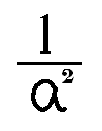

We were trying to solve the problem doing the calculations with that interpretation, and we were getting nowhere near the answer, until we realized the book meant a(1/2), not 1/(a2).
The expression should have looked more like this:

This simple example shows that, when reading mathematical expressions, we process the information in a way that seems like a hybrid of how we read text, and how we look at two-dimensional images. In reading math expressions, it is very important to take into account visual clues like the size of each symbol, and the relative position they hold to each other, their spatial arrangement in the page, and how close or far away they are from each other. This is essential because mathematical notation implicitly uses our instinctive understanding of two-dimensional images to convey the fine details of each expression’s precise, hierarchical structure. This also has to do with the familiar PEMDAS rules of evaluation, and is key to getting the problems right. Correctly applying the PEMDAS rules is relatively easy when a particular expression is all contained in a line of text. However, when we start dealing with sub-indexes, summation notation, roots, integrals, derivatives, rational functions, powers of powers, upper and lower limits, fractions of fractions (and especially with combos of all of the above); deciphering an expression's structure requires a visually detailed inspection of the two-dimensional arrangement of all the different symbols making up the expression.

As opposed to a line of text, the structure of a mathematical expression is not necessarily linear. Most often than not, the hierarchy branches out. Mathematical expressions include symbols for operations. Operations usually are functions of two arguments, or parameters. These are called "binary" operations, like addition, or multiplication. Often we work with "unary" operations, or functions of only one argument, like the square of a number, or its absolute value. Sometimes we work with operations that take more than two arguments. The basic fact is that functions have input arguments, and produce output values that can, in turn, be used as inputs by other functions. A mathematical expression has a hierarchical structure given by all the connections between input values, and the functions using them. The written representation of a math expression has to present all these connections unambiguously. The set of all these connections between symbols constitutes a hierarchy that we call a rooted tree. This term (bear with me) denotes an acyclic, connected, directed graph with a finite set of nodes, including one main node (the tree’s “root”). Upon this underlying structure, each node gets associated with a particular symbol representing either a constant, a variable, or an operation. Let’s look, for example, at the quadratic formula (the formula used to solve quadratic equations):
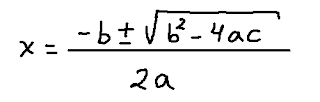

Below we show the rooted-tree that is the foundation for the hierarchical structure of the quadratic formula (not including the equal sign, just the right-hand side); along with the constants, variables, or operations that are associated to each node in the graph. Looking at the arrows, you can see each individual symbol is connected to the one directly “above it” in this hierarchical structure:
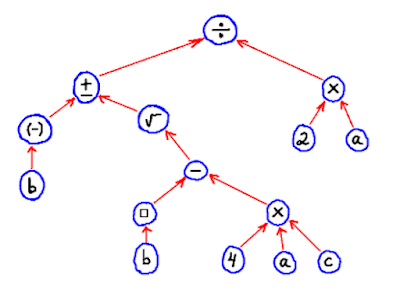


In the diagram above, I use the square shape to represent the application of the function "taking the square of b." Note we are still making an implicit assumption based on our visual processing of images. We are relying on the left-right distinction to implicitly give the correct ordering for the arguments of division, and subtraction, the two operations used here that are not commutative.
The rooted tree makes apparent the formula's underlying, hierarchical structure, it shows all its components, and their individual connections. We could philosophically argue that this structure is what the quadratic formula "really is," independently of the format we choose to represent it. My purpose here, in showing the rooted tree associated with the formula's structure, is to make the point that the linear simplicity of written text falls short when it comes to encoding complex mathematical expressions. True, with suitable conventions, and enough parenthesis, you can make almost any math expression fit into a line of text but that does not make its structural complexity go away one bit. For example, you can write the quadratic formula like this:

x = (-b [+/-] sqrt(b^2-4ac))/(2a)

It is all written in a line of text but the hierarchical, branching order of its operations is still the same. Many students (and, consequently their math instructors) deal all the time with the relative difficulty of correctly deciphering the hidden structure of mathematical formulas based on its written representation. This is a fundamental skill that heavily affects students' performance in math, and therefore, their grades, and their future career choices.
Not long ago I wrote a related post in this blog, titled "Math is not English."

People who are not "math-oriented" may find this hard to believe but actually, the mathematical syntax, symbols, notation and conventions currently in use (at least up to Calculus and Linear Algebra) are pretty much the easiest, clearest, simplest, most convenient way mathematicians have found (laboriously through the centuries) for writing and reading mathematical formulas. Believe me, the guessing and reasoning behind the formulas is hard enough. No mathematician is interested in making the notation artificially complicated, quite the contrary.

This finally leads me to the reason why I wrote this post in the first place. I recently attended an online get together of fellow Twitter math enthusiasts. The discussion centered on the large gap between text editors, and math equation editors; particularly with the purpose of publishing, storing, and searching mathematical expressions on the Internet. Compared to the wide availability of high-quality word processors, text editors, and text-based search engines, there seems to be a perceived scarcity of free, online tools for authoring and delivering math expressions online, as well as for searching math documents by their mathematical formulas, not by keywords. These topics immediately made me think of the fundamental structural difference between text and math I mention above because, as a math tutor, I have to help my students deal with this chasm practically every day.
Mathematicians would absolutely love a software package capable of identifying, and extracting the hidden, hierarchical structure of a math formula from the handwriting they could do on an electronic tablet with an electronic pen. My contention is that one of the main reasons this type of software does not yet exist, is because of the large extent to which the conventions of current mathematical notation rely on our unconscious, instinctive, biologically hard-wired, visual processing of images to convey mathematical meaning. As crazy as it sounds, and no matter how many of my students I know would disagree with this statement, we have come a long way in making math very easy to read and write on a piece of paper. However, we have done so by tapping into our biological processing of images, and this has inevitably put us at a disadvantage when it comes to entering that information into a digital format.

Anyway, the question in the title of this post: "Is there a connection between Mathematical Writing and Fractal Geometry?" is motivated by the non-linearity (branching out) of hierarchical math expressions, on one hand, and our hybrid way of reading them, on the other; as something between dimension one (plain text), and dimension two (full images).

Sunday, June 28, 2009

"Made-up" operations

Sparing some test-takers the abstraction of modern algebra

Here is a specific type of problem that usually confuses many students who are preparing for standardized tests like the GMAT, GRE, and SAT:

Let the operation Δ be defined as aΔb = (a2 - b)/(a+b) for all real numbers a, b such that a does not equal -b. If a = 15 and aΔb = 5, what is the value of b?

One source of confusion here is the symbol used to represent the operation (either Δ, or θ, or @, or other similar symbol). To the student, these symbols seem unusual, odd, strange, or weird. The main confusion source is the word “operation” itself, referring to the odd-looking symbol. This causes a particularly strong reaction in students who have been away from school a long time, not taking any math classes in the last several years. When they hear or read the word “operation” in connection with math, they automatically think of the four classic operations they are familiar with since elementary school: addition, subtraction, multiplication, and division. They know that weird-looking symbol is none of them.
When they ask me questions about this type of problem, often the conversation unfolds like this (using the example problem above):
~~~~~
Student: What the heck is that symbol Δ? That is not an operation, is it?
Tutor: No, you are right, it is not an operation. Nobody uses that in math. It is nothing like the quadratic formula, or something. No.
Student: So, why are they saying it is an operation?
Tutor: Oh, do not worry about it, it is nothing, they are just making it up. It is a made-up operation.
Student: But, why? Just to confuse me?
Tutor: You got that right. They want to see if you can plug in whatever values they give you, and go along with whatever expression comes out of that. For example: let’s say a=1 and b=2.
Then we have 1Δ2 = (12 – 2)/(1+2) = -1/3. Now, I bet you can do this other example: if a was 3 and b was 5, how much would 3Δ5 equal?
Student: So, is that it? I just have to plug in the numbers?
Tutor: Yes, that is right, the numbers, or the expressions the problem gives you.
Student: O.K., then: (152-b)/(15 + b) = 5. Oh, well, now I have an equation, and I can solve for b.
Tutor: Perfect.
Student [after solving the equation]: Pfff! That is easy.
Tutor: Good, excellent!
Student: It was just plugging in the numbers, and solving the equation but they make it seem so complicated at the beginning with that weird symbol.
Tutor: Yes, I know. That is exactly what they do. So, just be prepared for those weird-looking, out-of-the-blue, made-up operations. Do not let them surprise you.
~~~~~
In abstract algebra, a binary operation on a given set is a function taking two input values from that set, and returning an output value in the same set. The set does not even have to be a set of numbers. So, if you want to get technical, the question of whether or not a formula like (a2 - b)/(a+b) defines an operation, really has to do with the domain and codomain of the function.
In this particular example (a2 - b)/(a+b) is not a binary operation on the set of real numbers, because the restriction that the denominator needs to be other than zero excludes the set {(x, -x)} from the function’s domain. You could call it a partially defined operation. Other formulas, like sqrt(ab), the geometric mean of two numbers, are operations only on the set of positive numbers, because the product ab needs to be positive for the square root to be defined.

However, I do not get into any of these abstract concepts with my students, unless they specifically ask, with curiosity, and with an open mind because, otherwise, it would be Greek to them, and it would be a waste of their time. In most cases regarding this particular type of confusion, test takers only want validation that they are not crazy, and that they did not totally miss a whole classic operation (like addition, subtraction, multiplication, and division) during elementary and middle school. So, I want to address their concern, and make sure they know I understand their question; the source of their surprise and confusion. I want to increase their confidence in themselves, that they can successfully solve the problem on their own. To do it, they do not need to know anything about abstract binary operations in algebraic structures. That is a topic CSET takers need to pay some detailed attention to but not GMAT, GRE, or SAT takers. There is no time for me to go into such topics with them. The typical student only wants to know how to solve the problems. They are quite comfortable with their familiar belief that the word “operation” must mean addition, multiplication, subtraction, or division. They are not paying me to make them go through all the mental gymnastics it would take them to overcome their resistance to expand their concept of “operation.” So I just give them what they are looking for, that is, the fastest way for them to be able to solve the problems, and to feel good about it.

Saturday, June 20, 2009

Who is driving?

Transferring control of the tutoring session to the student

Along the lines of my previous post, about how I help students in our math tutoring sessions, here is another ingredient of my tutoring method: I transfer as much control as possible to the student, over the tutoring session. The keywords here are “as much as possible,” meaning, making sure the students still learn all they need to learn. I do this by asking questions like: “What do we have today?” “Do you have any specific questions?” “What topics would you like us to review?” “What topics is the next midterm going to cover?” “Would you like to see a shortcut for doing that faster?” “Does this explanation make sense?” “What problem do you want to do next?” and so on and so forth. This is a major difference between tutoring one-on-one, a single student at a time, versus teaching a large class. A teacher in the classroom has to cover a large amount of material under a tight schedule; while the tutor can focus exclusively on the specific issues the student is having difficulties with. In a large class every student has different questions, and different difficulties, so the teacher cannot allow the lesson to wander all over the place by following the interests, questions, and difficulties of every single student in the class. That is practically impossible in traditional education. However, in a one-on-one tutoring session the tutor can answer most of the student’s questions without getting sidetracked. Actually, answering all specific questions each particular student may have, is not only possible but indeed necessary for the tutoring session to be successful. That is the very essence of private tutoring, as opposed to teaching a class of many students. Very early on in my tutoring business I discovered the educational benefits of developing the tutoring session along the needs of the individual personality of each student. Students learn better when they are learning at their own pace; when they are encouraged to ask all questions they have about a particular topic; when the instructor checks with them if the explanations make sense to them; and when the instructor lets them choose the order in which to work out the problems. Whenever I notice a student is showing signs of being bored, uninterested, impatient, or irritated, I try to find a way to give the student more control over the tutoring session. The ideal is to have the tutoring session resemble a casual conversation as much as possible. This cannot be done in the same way with every student. Each student is different. However, there are two very broad categories in relation to this topic of controlling the flow of the tutoring session. On one hand we have the working adults who are preparing to take a standardized test, and who pay for the tutoring sessions out of their own pocket. On the other hand we have the children, and teenagers, whose parents made the decision for them to take tutoring sessions. In the latter case the parents are paying for the tutoring sessions, not the students themselves. There are exceptions to every rule but, in general, I find it easier transferring control of the tutoring session to the working adults who are paying for themselves, than to the children or teenagers whose parents are paying for them. Working adults who pay out of their own pocket are already motivated enough to learn. They made the decision to hire a tutor; and they took the trouble of finding one. They usually have a better idea of why they are taking the tutoring, and what they want from it. On the other hand, the children who come to the tutoring because their parents made that decision for them, they are in a different situation. Often they are still struggling to get over the fact that they have to learn math even when they do not like it. Letting children start talking about whatever they have in mind leads much more quickly outside of math than it does with working adults. It may not show when viewing the process from the outside but actually, transferring more control of the tutoring session to the student, takes a lot more attention, and effort from the tutor than it would take otherwise but it is much more effective as far as the student achieving educational results.

Wednesday, May 20, 2009

To like or dislike math is an individual choice

Helping students regardless of whether they like math

One basic way I help my students is by respecting their right to dislike math. I do not try to make them like math. I refrain from insinuating, or even thinking to myself, that they should like math, because I believe they are free to make that choice by themselves. I am no longer one of those teachers who are always telling students how wonderful, important, or beautiful math is, and that they should like it. I personally love math but I very well know it is one of the least popular subjects among students. As a math tutor, I see my students as human beings first, then as clients, then as students. I know they hire me to help them pass their exams with a good score, not to make them like math, and I totally respect that. Often my students start their first session telling me they are not good at math, or they have always had problems with math, or they do not understand math, or they do not like math, or they hate math. I always listen to them, I acknowledge what they say, and I tell them that it is O.K., meaning, I have no problem with them hating math; I do not feel offended that they do not like math; I do not think they should like math; and I am not going to judge them, or criticize them, or give them a hard time just because they do not like math. Most times I do not even have to say it. Just a nod of the head, and a brief comment like “Yeah, that’s alright” make them feel comfortable with me from the very beginning because they perceive my attitude is sincere. Somehow they realize that, plain and simple, I could not care less whether they like math or not. It is their choice. I am still going to help them to the best of my ability. I do not believe there is anything wrong with them just because they do not like math, or are having problems with math. Once this basic understanding is established, that I am not going to try to change them, they trust me, and they are much more open to what I have to say to help them. In this way I can help them much better.

Sunday, May 03, 2009

Negative exponents

Using powers of two for explaining the concept of negative exponents

Negative numbers confuse many students. Usually students tend to struggle with almost everything related to negative numbers. From the very concept of using the (-) sign to refer to conventional spatial directions (left, down, back), to the different rules for adding, subtracting, or multiplying positive and negative numbers; there are plenty of instances where the (-) sign is overlooked, or misinterpreted, resulting in a wrong answer. Given that a high number of wrong answers produce a low score, it is only natural for many students to react defensively whenever a new concept involving negative numbers shows up in their radar. This is the case for negative exponents. Remember that the first definition of exponent (positive) most students are introduced to is: “the number of times you multiply a number times itself.” When one tries to apply this definition to the case of negative exponents it does not make sense because, how do you multiply a number times itself “minus once,” or “minus twice”? One possible answer is that, when it comes to negative exponents, you do not multiply but you divide instead. Even with that interpretation the rule still needs some adjustment because, if you start with a number a, and you divide it by itself once, you get 1 as a result, so you would think a-1 was 1 but that would be wrong because 1 = a0, whereas a-1 = 1/a.
In order to avoid this kind of confusion, I follow another approach: By asking very simple questions I help the student build a list of powers of 2 from 2 to 1024, each related to their corresponding positive exponent. Then we notice the patterns how the numbers change, and how the exponents change. Then we move backwards all the way to the beginning of the list, and beyond, continuing into fractions, on one column, and into negative exponents, on the other column. In this way it becomes crystal clear to the student how the exact same pattern correlates the negative exponents to the fractions, and even the general formula a-n = 1/an becomes apparent. I have successfully used this method many, many times, and so far it has worked wonderfully, clearing away all confusion and anxiety students of all ages had around negative exponents. The key to this approach is being very thorough, and asking the right questions, in the right way, at the right time.